
Looking for more expert insights?
Our innovative solutions put your customer front and center.
This post is part 4 of a 4-part series on the customer centric supply chain.
In today’s business environment, delivering a great customer experience is key to drive business, to differentiate yourself from competitors and to increase customer life-time value. To create outstanding experiences, you should put the customer at the heart of everything you do. Customer centric organizations typically adopt a culture where every employee and every process, customer-facing or not, acts in the best interest of the client. This requires a shift from functional silo thinking to cross-departmental collaboration.
Many companies are still organized in functional silos, with separate sales, marketing, production, and supply chain departments. Their processes are typically installed from a functional point of view, focusing mainly on efficiency, and reaching departmental goals. To become truly customer centric, it is however important to align your internal way of working with the journeys of your customer.
For this post, we have listed 4 stages that are often used:
Every stage in this journey entails a process where various functional areas meet. To become customer oriented, the touchpoints that clients have with your company need to be mapped on the internal operations. Next, you should determine the customer satisfaction per contact point, both via external as well as via internal interviews.
By integrating the customer and employee journeys, you will stimulate and propagate the customer-first mindset, while creating maximum value for both client and company.
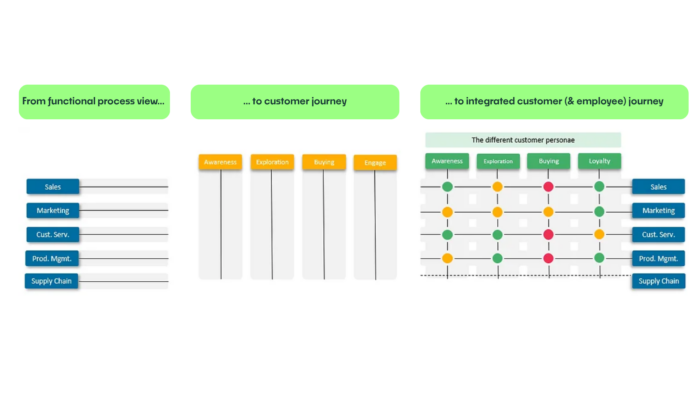
We supported a client in creating such customer centric processes. After mapping customer and employee experiences like explained above, we found that both were strongly intertwined: bad scores from a customer point of view were met by low scores from an internal perspective and vice versa.
Most problems were identified throughout the exploration phase:
Inside-out: Internal cross-functional discussions with marketing, sales & product management confirmed:
Outside-in: Customer interviews showed that customers experienced difficulties in browsing the product assortment and finding the right product for their specific needs.
To solve these issues, we proposed a two-step solution:
By considering both the outside-in perspective and the inside-out perspective, the overall experience has been brought to the next level.

This post is part 2 of a 4-part series on the customer centric supply chain.

At Chronion, we supported businesses across a variety of industries become more customer centric. Through this journey, we’ve developed and refined our Customer Excellence Model, which focuses on four key areas for improvement.

In part 2 of our Consumer Centric Growth series, we explore how leading companies move beyond optimising what already exists and start by identifying where value is created for consumers, shoppers and retailers.