
Looking for more expert insights?
Our innovative solutions put your customer front and center.
Purchasing plays an important role in the supply chain process and is essential in almost every organization. However, in a lot of companies, purchasing is still perceived as a supporting function, while we believe that it should be considered as a strategic function as well. When an organization does not sufficiently recognize the value of the purchasing department, it does not fully capture its value. In this article, we want to clarify the different roles a purchasing department can fulfill and emphasize that the role of a purchasing department can vary depending on the context or complexity of the broader organization. Finally, we also want to summarize the trends we see in organizations regarding purchasing and the value they can create.
A purchasing department within a company is intrinsically responsible for purchasing goods, services and materials needed to carry out business activities. They are the intermediary between internal customers and suppliers.
Even though the roles of purchasing vary, there are some activities that every purchasing department fulfills in one way or another:
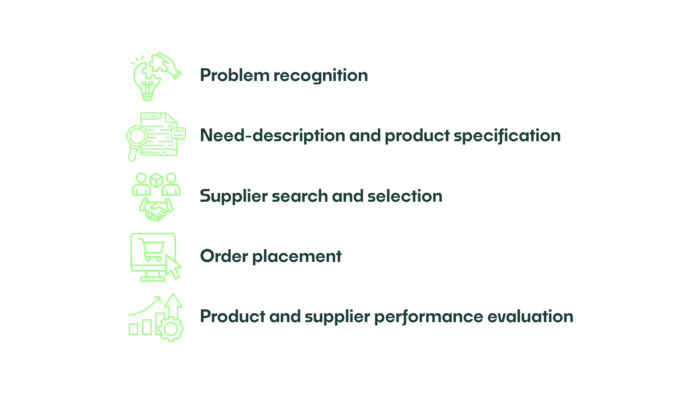
These large blocks of activities can be executed differently based on the nature of the product/service, and the organization/industry the purchasing department is operating in. One distinction that is often made is the difference between direct and indirect buying.
Direct buying = the process of buying materials, goods and services that are directly related to the final product or service.
Indirect buying = buying goods and services that support the business operations but aren’t part of the final product.
Direct buying is often of more strategic importance, leading to more emphasis on supplier relationships and supplier evaluation criteria other than cost (e.g. quality, lead times, reliability, financial stability …). Indirect buying is, generally speaking, more transactionally oriented and therefore is cost efficient often the leading indicator.
The purchasing department tries to provide the best possible support to the various departments in the company and can add value in several areas, of which the most important ones are improving cost efficiency, improving quality, and ensuring operational excellence.
First of all, centralized procurement can add enormous value through cost savings. Economies of scale can be achieved for both direct and indirect buying by combining different orders from different parts of the organization. This gives the experienced buyers more bargaining power to negotiate better prices and negotiate discounts. By setting price agreements with suppliers, goods and services can be purchased in a faster and more efficient manner at a consistent, and often lower, price. Purchasers typically perform spend analyses on a regular basis to spot cost‑saving opportunities. The combination of combining volumes, and centralizing a streamlined buying process, can reduce overall costs enormously.
A second way for purchasers to add value is through their relationship with suppliers. By maintaining good contacts with suppliers, they can improve the quality of the goods/services delivered and can play a critical role in resolving operational problems that might occur along the way. In addition, they have a good overview of the various suppliers and can thus create a list of preferred suppliers to share with the internal customer to help them find the best suited supplier. This list of preferred suppliers can ensure that the diversity of suppliers is reduced, and that the quality delivered is according to company standards and expectations.
Finally, a purchaser also plays a very important role in risk management before, during, and after the execution of any project. Since the purchaser has good contact with both suppliers and the internal customer, they are the ideal person to bring these parties together. The purchaser can look at a project from the purchasing perspective and the internal customer from the technical side. By including a purchasing perspective from the beginning of a project, several risks can be addressed before it is too late. Examples are regulatory compliance, supplier diversification, …
In conclusion, the purchasing department is not just an administrative department that only needs to order products at the lowest possible price. Through good cooperation with internal customers, they can add significant value in quality assurance, risk management, and operational excellence as well.
Procurement is subject to the same trends we see in other supply chain areas, such as the development of digital solutions that enable automation and create visibility. Digital procurement tools, or more general technologies such as RPA and artificial intelligence, fuel automation. This will remove many of the administrative tasks from buyers, allowing them to focus on more value-adding activities, such as the ones we discussed previously. The focus will and should be more on innovation and developing long-term relationships with suppliers. Some companies go as far as offshoring purely operational and administrative tasks to free up more time for buyers for tactical and strategic activities. In any case, we are strong believers in a pragmatic approach to procurement optimization. State-of-the-art procurement processes supported by innovative technologies are only appropriate in areas where they add value. Automation and innovation for the sole purpose of it, is never good idea.
Procurement will also play a vital role in the sustainability journey of companies. For several years now, the traditional single criterion approach based on lowest cost bidding is no longer supported in contemporary supply management. As already mentioned, other criteria such as quality, reliability, reputation, innovation, etc. play an increasingly important role. In the last couple of years, the sustainability criterion has been added to this list and is becoming increasingly important. To achieve a company’s sustainability targets, sustainable sourcing is indispensable.

A supply chain is by definition a network of organizations working together to create value and produce and deliver products and services to consumers. In this process, businesses interact in many ways with each other.

The design of end-to-end supply chain planning processes has become an increasingly critical topic for organizations.

Optimizing logistical activities is a vital part of any supply chain since the benefits vary from enhancing operational efficiencies and creating competitive advantages, to improving your sustainability.