

Looking for more expert insights?
Our innovative solutions put your customer front and center.
After several years in which inflation drove topline growth, the consumer goods industry is facing structural challenges that are becoming increasingly hard to ignore. The industry is approaching a turning point, where traditional growth models are no longer delivering the results they once did. These shifts require a fundamentally different approach to growth. At Chronion, we have developed a pragmatic, consumer-centric approach that helps companies unlock and sustain organic growth.
To understand why the Consumer Goods sector is reaching a turning point today, it is useful to look back at how the market has evolved over the past few years.
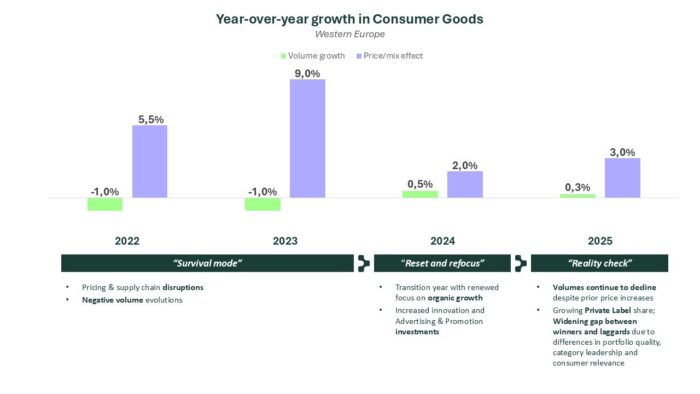
The period 2022–2023 was largely defined by a “survival mode”, with major pricing and supply chain disruptions forcing companies to respond to rapidly increasing costs, while volumes declined.
In 2024, the focus shifted towards a “reset and refocus”. Companies aimed to reignite organic growth, increasing their efforts in innovation, advertising and promotional investments. However, these initiatives delivered only limited volume recovery.
As we move into 2025, the market enters a clear “reality check”. Volumes are still below pre-2022 levels, pointing to a structural shift rather than a temporary downturn. At the same time, the market is becoming increasingly polarized: private labels are gaining share among price-sensitive consumers, while strong A-brands consolidate their position, leaving mid-tier players increasingly squeezed.
The challenges that consumer goods companies are facing do not exist in a vacuum. The broader retail landscape has undergone a structural transformation that is fundamentally altering the dynamics between suppliers and retailers.
Changing consumer behavior is at the root of this shift. Shoppers are moving online, purchasing more frequently across multiple channels, and showing decreasing loyalty to both brands and traditional retail formats. This has opened the door to a new wave of digital-first and alternative retail models, ranging from large online marketplaces to direct-to-consumer concepts and subscription-based services, all capturing a growing share of the consumer wallet.
As a result, the financial position of traditional retailers is under increasing pressure. Many have responded by consolidating purchasing power through buying groups and M&A, strengthening their position in supplier negotiations. However, these moves have not structurally improved the situation, with financial pressure across the sector remaining high.
The inevitable result? A rising number of conflicts between manufacturers and retailers during negotiation periods, each party fighting for their slice of a shrinking pie. Left unaddressed, this dynamic leads to the worst possible outcome: mutual value destruction, where both sides lose.
These dynamics are best understood through a concept we frequently use to frame these challenges: the Value Erosion Spiral, a self-reinforcing cycle that brands need to actively avoid.
It typically starts with declining volumes, prompting manufacturers to take corrective actions such as reducing marketing spend, scaling back trade investments or relying more heavily on short-term pricing and promotional levers. While these measures may provide temporary relief, they often come at the expense of long-term brand strength.
As investment levels decrease, brands lose visibility, driving lower awareness and consideration and ultimately accelerating the decline in Rate of Sales. At the same time, reduced investment weakens relationships with retailers, increasing the risk of delistings for low‑rotating SKUs, again leading to volume losses. What starts as a short-term correction evolves into a structural downward spiral that becomes increasingly difficult to reverse.
The persistence of this dynamic is well documented in marketing science literature. Research by the Ehrenberg-Bass Institute demonstrates that once brands enter a declining trajectory, they tend to continue losing market share over time, with erosion occurring gradually but consistently year after year.
So, what separates the winners from the underperforming players in this environment? In our experience, it comes down to mindset as much as capability.
The companies that are navigating this landscape successfully are those that resist the temptation to manage their way through short-term pressure by cutting investment and relying on price. Instead, they double down on understanding where genuine value lies for consumers, for retailers, and for themselves, and they build the commercial capabilities to capture that value systematically.
This shift requires a move away from the traditional reactive, experience‑based decision-making towards a more consumer & shopper centric approach to growth. It becomes increasingly important to understand which consumer segments and occasions generate the majority of the category potential, and which propositions are required to capture this potential in a profitable and sustainable way. At the same time, it is equally critical to understand the consumer & shopper journey of these priority segments at a sufficiently granular level, enabling tactical optimization of key touchpoints, both directly and in close collaboration with retail partners. After all, for both branded and private label players, retailers increasingly expect suppliers to come with differentiating growth plans that strengthen their positioning and create shared value for their shoppers.
The figure below highlights the key differences between a traditional market-back approach and a consumer & shopper-centric growth approach. It shows how we help companies redefine where growth truly comes from, enabling a sharper focus on the regions, brands, products, customers and activation levers that can genuinely win. At the same time, it illustrates how we build future-proof operating models and capabilities that embed this way of working across the organisation.

In the next two parts of this series, we will build further on this framework and show how this shift can be made actionable in practice through our approach. We will zoom in on how consumer segments, value drivers and shopper journey insights, as illustrated above, redefine not only where growth sits, but also how it is translated into concrete strategies, activation tactics, and the way organisations operate and build capabilities.
At Chronion, we partner with consumer goods companies to unlock commercial growth: understanding what creates real value for consumer & shoppers, translating it into an actionable growth strategy, ensuring disciplined tactical decisions (innovation, pricing, promotions…), and enabling impactful executions.
The Consumer Goods sector is undergoing a structural reset. The question is not whether companies will be affected, but how they will respond. Those that succeed will be the ones that translate consumer value into a coherent and sustainable growth model.
Interested in exploring what this means for your business?
Contact us.
In part 2 of our Consumer Centric Growth series, we explore how leading companies move beyond optimising what already exists and start by identifying where value is created for consumers, shoppers and retailers.

This post is part 3 of a 4-part series on the customer centric supply chain.
Replenishment planning is a crucial aspect of supply chain management that involves the systematic process of restocking products to meet customer demand while maintaining optimal inventory levels.