
Looking for more expert insights?
Our innovative solutions put your customer front and center.
This post is part 3 of a 4-part series on the customer centric supply chain.
Whether it is B2B, B2C, B2retail, a strong value proposition is fundamental in every kind of business. In any environment, different customer types with specific needs can be distinguished, so organizations should make sure to tailor their offering accordingly by creating segment specific value propositions. Each proposition should satisfy a specific target customer segment based on a customized set of products and services to maximize value for both customers and the company.
Nowadays, customers expect much more than a ‘one-size-fits-all’ solution. Expectations, needs and beliefs may differ significantly per target group. For this reason, it is important to understand who the customers are and what they value.
E.g.: Typically, customer requirements for commodity products differ from the expectations customers hold for specialty products. For premium goods, customers expect higher quality or more service and support compared to commodity goods. To be able to optimally serve both segments and come with strong propositions, creating in-depth customer profiles should be the starting point.
After having defined the relevant customer groups, in a next step this should be streamlined into segment specific offerings.
Important to take into consideration is that this goes beyond the product: it involves all the different interactions and touchpoints with the customers. It usually starts by exploring and validating the product & service fit with the specific market needs and the existing channels for customers. If a customer only shows interest into basic products, you probably should not offer your entire portfolio of premium products and services. This can reduce the risk of brand erosion or even price erosion that could appear when the extra services provided are not valued by a customer.
In certain industries, taking a closer look at capacity management per segment is highly relevant as well. E.g.: prioritization should be evaluated, a decision on what stock policy to apply should be taken, and so on.
Besides the tactical considerations described above, service levels, pricing, contracting, approval flows and commercial interactions should be reviewed.
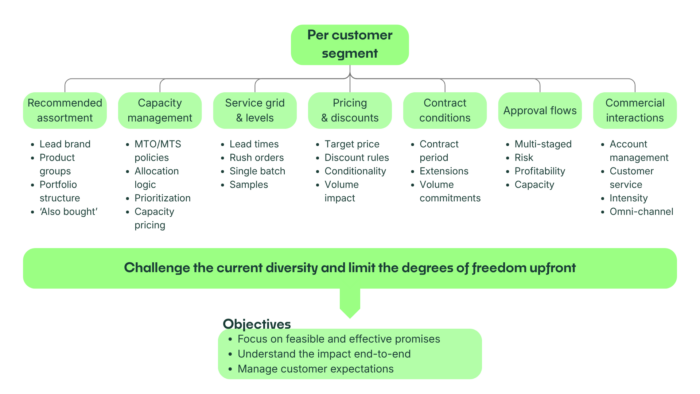
Ultimately all these different elements must come together into a concrete offering, with the objective to articulate a feasible and effective promise per customer segment. It is however crucial to recognize the overall end-to-end impact, because all these different options come at their own cost. As such, it is of utmost importance to manage customer expectations appropriately in order to run an efficient business and stay close to the company value strategy.
In the upcoming post, we will deep-dive into customer centric processes . Stay tuned!

This post is part 1 of a 4-part series on the customer centric supply chain.

Pricing solutions pop up like mushrooms.
It is hard to get a clear view on which solutions are best suited in the different phases of an end-to-end pricing process.

The design of end-to-end supply chain planning processes has become an increasingly critical topic for organizations.