
Looking for more expert insights?
Our innovative solutions put your customer front and center.
This post is part 1 of a 4-part series on the customer centric supply chain. Find the overview of all articles in this series below.
Making strategy explicit contributes to consistency and offers direction within your organization. It creates focus and can motivate people as they are working towards a common goal. In a fast-changing business environment, companies should try formulating a strategy that aligns their internal capabilities with the products and services they deliver. On top, they should always include the voice of the customer. This will ultimately result in an offer that delights customers and creates real value for them.
How can coherence between an organization’s products and services, and its internal capabilities be achieved? Business advisors Treacy & Wiersema [1] link this to strategic value levers. According to their well-established model, three value disciplines can be leveraged to ultimately create maximum value for the customer:
Each of these disciplines are characterized by a set of critical success factors (CSF): competences that make an organization prioritize different elements of their offering. CSF are typically linked to either price, product, broader service, or experience.
[1] Treacy, M. & Wiersema, F. (1995). The Discipline of market leaders. USA: Addison-Wesley. 224p.
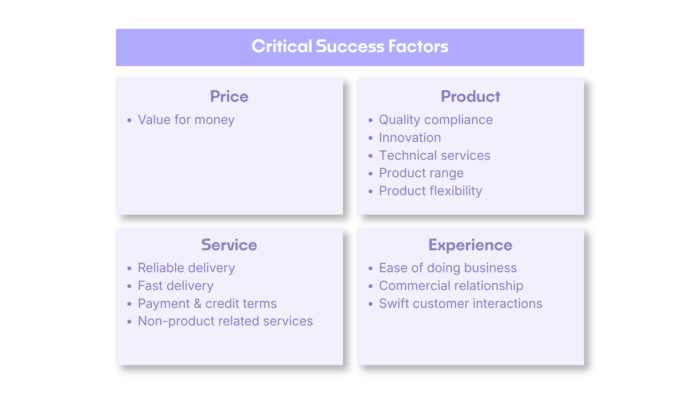
A company must assess to what extent each factor contributes to its success to decide which value strategy to pursue. E.g.: Is it winning in the market thanks to excellent value for money or is success driven by delivering consistent high quality?
A reliable and efficient way to do this, is by evaluating whether each CSF can be classified as an order winner, an order qualifier, or a non-issue.
For one of our customers, we categorized CSF for two different value propositions.
For the commodity products sold to broad audience, the chemical company defined value for money, quality compliance, reliable delivery, and swift customer service as order winners. This resulted in a value strategy focused on operational excellence where automation and cost efficiency are key.
For their specialized products, only sold to a selected group of clients, competences like reliable delivery or quality compliance were merely perceived as order qualifiers. The identified order winners for this top product segment are innovation, excellent technical support and having close customer relationships. This specific set of CSF ultimately shaped a strategy linked to the product leadership discipline.
In the upcoming posts, we will further dive into the customer centric supply chain, explore why it is crucial nowadays and how to achieve it. Navigate to the next articles in this series:

Discover our guide to set up your Revenue Growth Managment capabilities.

This post is part 2 of a 4-part series on Customer Revenue Optimization and our Smart Account Planning process based on the Rootit® platform.

In today's fast-paced business landscape, organizations must constantly adapt to effectively address growth challenges.