
Looking for more expert insights?
Our innovative solutions put your customer front and center.
Supply Chain Resilience
Why do some companies manage to maintain performance, customer trust, and even growth during periods of disruption, while others struggle to recover? In recent years, supply chains have been exposed to an unprecedented combination of volatility, uncertainty, complexity, and ambiguity. Resource scarcity, geopolitical tensions, climate‑related disruptions, cyber threats, and labour constraints increasingly challenge the stability of global value chains.
Yet supply chain disruption is not limited to large‑scale crises. Supplier failures, transportation delays, quality issues, or internal operational breakdowns can have an equally significant impact on service levels and financial performance. In this context, supply chain resilience has moved from an operational concern to a strategic imperative.
In this expertise post, we explore what supply chain resilience truly means, why traditional approaches are no longer sufficient, and how leading organisations are rethinking resilience as a source of long‑term value rather than a pure cost.
Traditionally, supply chain risk management focused on identifying risks, estimating their likelihood and impact, and defining mitigation actions. While this approach remains useful, it assumes a relatively stable and predictable environment. Today’s supply chains, however, operate in complex, interconnected networks where disruptions interact, cascade, and often emerge unexpectedly.
Hence, it is impossible to anticipate every disruption scenario. As a result, leading organisations are shifting their focus from preventing disruption at all costs to building adaptive capabilities that allow them to respond, recover, and continue operating under a wide range of circumstances.
Supply chain resilience can therefore be understood as the ability to:
This perspective moves resilience beyond contingency planning and embeds it into how supply chains are designed, governed, and operated.
To gain insight into the current level of supply chain resilience, we use a maturity assessment developed by the University of Applied Sciences Windesheim. It focuses on five core resilience dimensions that reveal where supply chains are robust and where vulnerabilities remain.
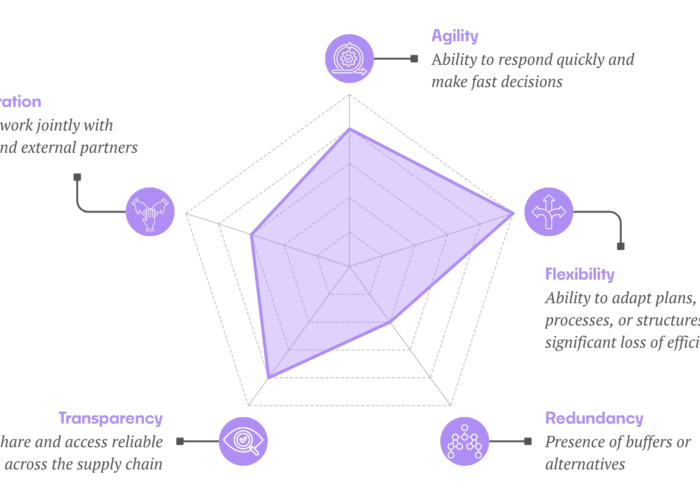
As a company, you can take steps to improve across each of these five dimensions. However, achieving meaningful impact requires collaboration with both customers and suppliers in these areas.
A recurring misconception is that resilient supply chains must excel across all five dimensions simultaneously. In practice, resilience is context‑dependent. What constitutes a resilient setup differs significantly depending on a company’s strategy, industry constraints, customer expectations, and regulatory environment.
For example, some industries operate under strict regulatory or quality constraints that limit sourcing flexibility. Others face physical or economic limits on inventory buffering. In such environments, resilience must be built through alternative levers, such as collaboration, visibility, or decision‑making speed.
The key is not to maximise resilience in abstract terms, but to identify the right balance of capabilities that support the company’s strategic priorities and risk exposure.
Supply chain resilience is often perceived primarily as a cost. Additional inventory, dual sourcing, backup capacity, or redundant processes are quickly associated with inefficiency. While it is true that resilience requires investment, this view overlooks an important reality: unreliable supply chains destroy value.
Missed deliveries, prolonged downtime, emergency expediting, lost customers, and reputational damage often outweigh the visible cost of preventive or adaptive measures. More importantly, reliability itself can become a differentiator, particularly in markets where customers face high costs of disruption.
Resilient supply chains protect revenue, stabilise operations, and support stronger customer relationships. When aligned with commercial priorities, resilience shifts from being a defensive expense to an enabler of competitive advantage.
Despite growing awareness, many organisations struggle to translate resilience ambitions into sustained impact. Based on discussions during our supply chain resilience roundtable and broader market observations, several challenges recur consistently:
These challenges highlight that resilience is not a standalone programme, but a characteristic of a well-aligned operating model.
Organisations that make progress in supply chain resilience tend to follow a structured line of thinking. They start by understanding their strategic intent and operating context, assess their current capabilities, and make conscious choices about where to invest and where not to.
Crucially, they recognise that resilience spans multiple levels:
Resilience emerges when these levels reinforce each other, rather than when isolated actions are taken in response to the latest disruption.
In an increasingly VUCA (volatile, uncertain, complex, and ambiguous) world, supply chain resilience is no longer optional. It determines whether organisations can sustain performance when conditions deviate from plan. However, resilience is not about building the most robust or most expensive supply chain possible. It is about making deliberate, context‑driven choices that balance risk, cost, and value creation.
The organisations that succeed are those that move beyond reactive risk management and embed resilience into their strategic and operational DNA. They understand that resilience looks different for every company, but that ignoring it is no longer an option.
Want to understand how resilient your supply chain really is? Get in touch to explore how a targeted resilience approach can strengthen performance and customer trust in your specific context.
Contact us!
Gathering market and competitive data to optimize pricing models is not always straightforward, especially in B2B. Opposed to the consumer market, B2B prices are less transparent, require effort to gather and are quickly outdated.

Many articles have been written about cost-to-serve, but despite this huge amount of information, a uniform definition for cost-to-serve does not seem to exist.

This post is part 2 of a 4-part series on Customer Revenue Optimization and our Smart Account Planning process based on the Rootit® platform.