
Looking for more expert insights?
Our innovative solutions put your customer front and center.
Many articles have been written about cost-to-serve, but despite this huge amount of information, a uniform definition for cost-to-serve does not seem to exist.
As the concept of cost-to-serve originates from supply chain it is often described as ‘an analytical approach identifying the supply chain costs to service a customer’. Whilst this is partially true, it is our opinion that cost-to-serve is much broader and aims at creating visibility of product and customer profitability and using these insights to improve your service proposition whilst reducing your costs.
One might argue that cost-to-serve is not a new concept and that most companies have mapped their cost-to-serve nowadays, but reality shows differently. Due the significant changes in the way we do business - increasing service (levels), the omni-channel approach, next day delivery, free returns, further penetration of EDLP (everyday low price) players – most companies face constant increasing costs to serve their customers.
The complexity in the supply chain still plays a big role in the total cost to serve customers, but also other aspects can contribute significantly to the cost to serve.
The above list is of course non exhaustive but shows that cost to serve can be across all parts of your value chain.
When talking to senior executives about cost-to-serve we often get one of below answers:
Whilst these all seem valuable reasons not to focus on cost-to-serve, none of them justify it.
Cost-to-serve is not about decreasing service, but exactly the opposite. It is about creating transparency on profitability and offering the right services for the right customers. Results typically increase customer satisfaction and bring bottom line growth!
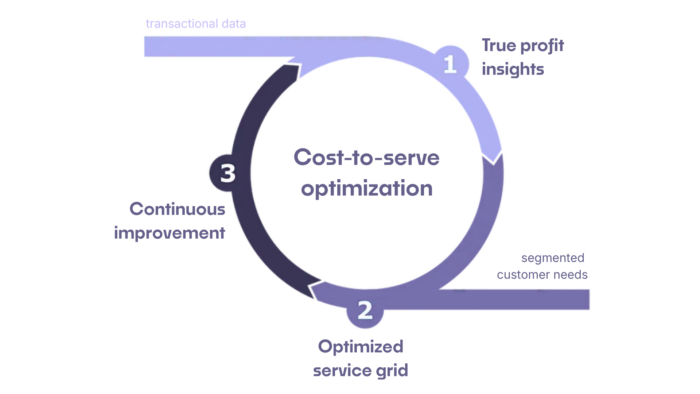
The Chronion cost-to-serve framework consists of 3 distinct steps:
1. Generate true profitability insights
A crucial first step in every cost-to-serve exercise is to remove perception and emotions by looking at facts and figures. By combining transactional data with a fit for purpose cost allocation model we obtain true insights in customer and product profitability. These insights will allow senior management and sales executives to better steer their resources with a direct result on bottom line performance
2. Review your service proposition/grid
A common pitfall of step one is to try to remove all unprofitable customers and products from the base. Whilst this approach is not necessarily wrong, more value can often be captured by turning unprofitable products and customers into profitable ones. Creating an enhanced service proposition is the next step in achieving this.The look and feel of a service proposition can take many different formats, but typically results in service policies, which translate the service proposition into operational guidelines. It stipulates for each service under which conditions the service is provided, for which customer segment, at which service level and whether it’s charged or not. Using the service policies will ensure resources are used in those areas where they yield the highest ROI.
3. Install a continuous improvement culture
Cost-to-serve should not be a one-time exercise, but a step-up towards a continuous improvement mindset in which customer profitability and customer satisfaction go hand in hand. Installing customized profitability dashboards for senior management which can be drilled down to detailed insights for account managers, ensure buy-in from all stakeholders in the value chain and facilitate the change towards a true customer-centric organization.

Discover our guide to set up your Revenue Growth Managment capabilities.

Purchasing is essential in every organization. In many companies, it is a supporting function but we believe it should also be a strategic function.

AI is one of today's most discussed technologies, set to transform industries and unlock opportunities.